From Homelessness to Freedom:

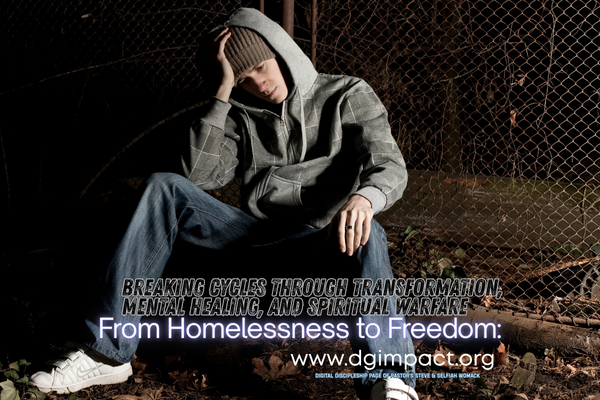
From Homelessness to Freedom: Breaking Cycles of Mental Struggle, Incarceration, and Spiritual Bondage
Introduction: The Crisis We See—and the Battle We Don’t
Across cities like Jacksonville and throughout America, homelessness is no longer hidden—it is visible on street corners, under bridges, in shelters, and in the lives of men and women trying to survive one more day.
Churches, outreach teams, and ministries are responding with compassion:
- feeding the hungry
- providing clothing
- opening shelters
- offering prayer
But despite these efforts, many people cycle back into homelessness again and again.
Why?
Because what we are seeing is not just a housing issue.
It is a layered crisis involving mental health struggles, incarceration barriers, military trauma, and spiritual warfare.
If we only address the visible needs, we will continue to see people return to the same patterns.
Because the real battle is deeper.
The Invisible War Behind Homelessness
Scripture gives us clarity in Ephesians 6:12:
“For we wrestle not against flesh and blood, but against principalities… against spiritual wickedness…”
This means the struggle is not just:
- economic
- psychological
- social
There is also an unseen battle influencing:
- thinking
- identity
- behavior
- life patterns
Many people experiencing homelessness are not just lacking resources—they are fighting:
- mental instability
- trauma
- addiction
- hopelessness
- spiritual oppression
If we only fight what we can see, we will never overcome what we cannot see.
The Enemy’s Strategy: Targeting the Vulnerable
Jesus exposes the enemy’s plan in John 10:10:
“The thief comes only to steal and kill and destroy…”
Now look at homelessness through that lens:
Steal
- identity
- dignity
- mental clarity
- opportunity
Kill
- hope
- purpose
- motivation
- family structure
Destroy
- stability
- relationships
- future potential
This destruction often unfolds over time through trauma, bad decisions, broken systems, and spiritual influence.
The Tipping Point: Why People Return to Homelessness
Many programs successfully help people off the streets temporarily.
They provide:
- housing
- support
- structure
But then something happens:
- people leave programs
- relapse into addiction
- lose housing
- disengage
Why?
Because they reached a tipping point where:
external change happened—but internal transformation did not.
And often, when someone begins to move forward, resistance increases:
- old habits resurface
- relationships pull them back
- fear intensifies
- mental instability returns
This is where Ephesians 6:12 becomes real.
This is not just struggle.
This is warfare.
Mental Illness: A Major Barrier to Stability
Mental illness plays a significant role in homelessness.
Many individuals have diagnoses such as:
- depression
- bipolar disorder
- schizophrenia
- PTSD
But there is an important distinction:
Some are clinically ill, while others are deeply wounded and untrained in how to cope with life.
Many have experienced:
- severe trauma
- abuse
- abandonment
- chronic stress
Without tools to process these experiences, the mind becomes unstable.
This leads to:
- emotional outbursts
- inability to maintain jobs
- difficulty following structure
- withdrawal or isolation
And over time, instability becomes identity.
But with:
- structure
- discipleship
- emotional training
- spiritual healing
many begin to regain clarity and stability.
Incarceration: The Hidden Wall That Keeps People Stuck
One of the most overlooked barriers to leaving homelessness is criminal history.
Many individuals have spent time in jail or prison.
This creates massive obstacles:
- difficulty finding employment
- housing restrictions
- loss of trust from society
- limited opportunities
But beyond the natural barriers, incarceration shapes mindset.
Many begin to believe:
- “This is all I’ll ever be”
- “I’ll always go back”
- “No one will give me a chance”
In some environments, jail becomes normalized—even expected.
This destroys long-term thinking.
Spiritual warfare element:
The enemy uses past mistakes to trap people in identity, convincing them they cannot change.
But that is a lie.
Transformation requires breaking agreement with the past.
Military and Veteran Barriers: Trauma, Transition, and Isolation
Many homeless individuals are veterans.
They carry unique challenges:
- PTSD
- combat trauma
- loss of identity after service
- difficulty reintegrating into civilian life
- isolation and loneliness
Military life provides:
- structure
- identity
- mission
When that is removed, many feel lost.
Without support, they may turn to:
- substance abuse
- withdrawal
- anger
- depression
Spiritual warfare element:
The enemy targets identity again—stripping purpose after service.
A soldier trained for battle returns home… but now has no mission.
Without a new purpose, many drift.
The Root Battle: Identity and the Mind
At the core of homelessness, incarceration, and mental instability is one central issue:
Identity.
People begin to believe:
- “I’m homeless”
- “I’m an addict”
- “I’m a criminal”
- “I’m broken”
These labels become internal truths.
But according to John 10:10, the enemy’s goal is to steal identity and destroy purpose.
Transformation begins when identity is restored.
The Missing Foundation: Seeking First the Kingdom
Many systems try to fix homelessness through:
- housing
- jobs
- programs
- medication
But Jesus gives the foundation in Matthew 6:33:
“Seek first the kingdom of God… and all these things shall be added…”
This reveals order:
Alignment before provision.
When someone receives help without transformation:
- they lose it
- misuse it
- or walk away from it
But when someone seeks God first:
- their thinking changes
- their identity is restored
- their decisions improve
- their life stabilizes
The Real Barriers That Must Be Addressed
1. Mental Instability
Without structure and healing, the mind remains chaotic.
2. Trauma and Emotional Damage
Unhealed trauma drives destructive behavior.
3. Addiction
Escape becomes a cycle of bondage.
4. Criminal History
Past mistakes become present limitations.
5. Military Trauma
Loss of identity and unresolved experiences create instability.
6. Lack of Life Skills
Many have never been taught how to function in stability.
7. Spiritual Bondage
Cycles that repeat beyond natural explanation.
The Solution: A Holistic Kingdom Approach
To truly move someone from homelessness to stability, we must address three dimensions:
1. Natural
- housing
- employment
- transportation
- life skills
2. Mental
- emotional healing
- coping skills
- structure and routine
- stability training
3. Spiritual
- identity in Christ
- renewing the mind
- breaking strongholds
- walking in authority
Discipleship: The Only Model That Works
Short-term help cannot produce long-term change.
Discipleship can.
It means:
- walking with people daily
- teaching consistently
- modeling stability
- building accountability
- correcting with love
It aligns with:
- Matthew 6:33
- Ephesians 6:12
- John 10:10
What Real Transformation Looks Like
Transformation is not instant—it is progressive.
It looks like:
- someone stabilizing emotionally
- someone maintaining housing
- someone holding a job
- someone overcoming addiction
- someone rebuilding relationships
- someone rediscovering purpose
These are not small steps.
They are victories.
Conclusion: From Homelessness to Purpose
Homelessness is not just a housing issue.
It is:
- a mental battle
- a life challenge
- a systemic barrier
- and a spiritual war
If we want to see lasting change, we must:
- go deeper
- stay committed
- teach consistently
- heal intentionally
- confront spiritually
Because according to Ephesians 6:12, this is not just natural.
According to John 10:10, there is an enemy at work.
And according to Matthew 6:33, the path forward begins with God first.
The goal is not just to get people off the streets.
The goal is to set them free.
Free in their:
- mind
- identity
- decisions
- future
So they can move from:
Homelessness → Stability → Purpose → Abundant Life